Most Americans would probably say that the capitalist West won the Cold War, but they would be wrong. They need to wake up and realize that, in the long run, Marxism has prevailed by worming its way into every aspect of American culture. Think about it: it’s been years since Disney last released a Marvel movie where a white man named Chris was the lead star; instead, it’s been pumping out cultural propaganda featuring scientific impossibilities, such as Black mermaids and women stronger with the Force than men. The titles of several recent books tell the story: Race Marxism, American Marxism, Unwoke: How to Defeat Cultural Marxism in America, America’s Cultural Revolution. Marxism is everywhere and comes in a million flavors. One is reminded of Thomas Pynchon’s great joke in The Crying of Lot 49 that a savvy conservative ought to be anticapitalist because of just how many Marxists capitalism tends to produce.
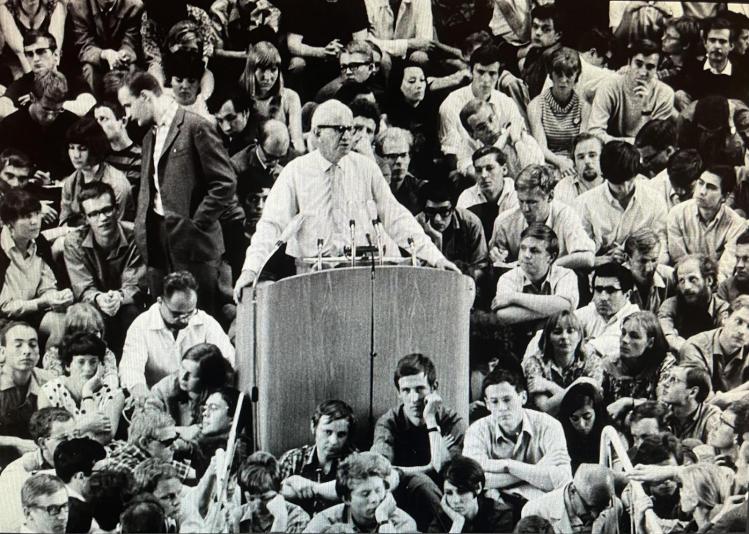
The country’s first Red Scare broke out in 1917, and there have been periodic recrudescences ever since. The 1950s was the heyday of hysterical anticommunism, the decade when the John Birch Society claimed that even Republican president Eisenhower was a secret Communist. In the 1960s the focus shifted to the universities, where red-blooded American undergrads were said to be falling under the dangerous influence of a sneaky European intellectual group known as the Frankfurt School. The German-born philosopher Herbert Marcuse (1898–1979) was singled out as the mastermind of a Marxist plot to march through the institutions and impose repressive toleration on all of us. After the Marxists took over academia, it was just a matter of time before your employer’s DEI department began demanding racial-sensitivity training after every colorful joke.
Such right-wing conspiracy theories and just-so stories, full of heat and devoid of light, have long cried out for a systematic exploration. Fortunately, we now have A.J.A. Woods’s illuminating new book The Cultural Marxism Conspiracy to connect all the dots. Woods, an intellectual historian, is interested in the role that conspiracy theories about cultural Marxism play on the right. He isn’t concerned about “refut[ing] all the claims that every critic of Cultural Marxism has made.” This is partly because so many of those claims are obviously not made in good faith. The people making them are not interested in accurately describing Marxism, cultural or otherwise. Even when critics of cultural Marxism are earnest, their theories are rarely intellectually substantive. What’s interesting is not the theories themselves but their strangely pervasive influence.
Woods shows how conservatives and far-right influencers like Paul Weyrich criticized the older American right for being “more interested in being right than winning power.” At a 2020 conference, William S. Lind, who effectively coined and popularized the term “cultural Marxism” in an American context, described its value to the right in affective rather than analytical terms. He argued that “cultural Marxism” works as a “delegitimizing tool in the United States, because many Americans regard anything even remotely Marxist as illegitimate.” As Woods writes, there was therefore no need to “quibble over definitions of Marxism or prove that political correctness is genuinely Marxist, because, as Lind claims, the American public does not generally care about these academic debates. Do not waste your time on research, Lind counsels.” The term “cultural Marxism” is best understood as a floating signifier under which the right lumps a vast array of disparate phenomena to undermine their credibility. Woods puts it well early in the book: “The elements of cultural Marxism/s have been deconstructed and reconfigured time and time again as reactionary political forces across the world search for new ways to justify their opposition to equality, democracy, and justice.”
The right’s strategy of reconfiguring the term “cultural Marxism” to delegitimize democratic forces goes back a long way. Woods draws parallels between this strategy and the Nazi theory that “Judeo-Bolsheviks” were aiming to control the world. But he argues that the contemporary crop of conspiracy theories about “cultural Marxism” have their origin in the 1960s. Many can be traced back to one man: Lyndon LaRouche. Beginning his career on the fringe left, LaRouche often attacked other progressive groups as fronts for the CIA and other dangerous capitalist forces. He inveighed against the counterculture of the 1960s—feminism, free love, and recreational drug use—as decadent and counterrevolutionary. These sentiments eventually led him and his followers to the far right, where they peddled the dubious theory that the Frankfurt School had successfully undermined the virility of Western civilization. While in prison for fraud, LaRouche wrote that the Frankfurt School had been established to “eliminate the ‘immunological factor against Bolshevism from Western European Civilization.’”
The material on LaRouche is fascinating, though it must be said that Woods’s account of the influence of LaRouche’s conspiracy theories on rightwing intellectual culture at large is a little thin. But the rest of the book effectively describes that culture’s propagation of anti-“cultural Marxism” narratives. Another member of the Frankfurt School, Theodor Adorno, famously described the way the “culture industry” banalizes culture. As if to confirm that description, accusations of cultural Marxism have been standardized so they can be easily, and endlessly, recirculated by right-wing media. A simplified, dumbed-down version of the theory makes it better propaganda and a more profitable grift. In the 1980s and ’90s there was a wave of alarm about Marxist academics preaching “political correctness.” In the past decade, a Trumpier conservative movement has openly conflated cultural Marxism with movements for racial equality. What began with guarded skepticism about “Woke” demands for racial equity has lately expanded into a hostile reassessment of the whole civil-rights movement, with Martin Luther King Jr. presented as a stealthy ally of the Frankfurt School. Today, as Woods demonstrates in the final chapter of his book, the moral panic about “cultural Marxism” has gone global, crossing into British and Brazilian political culture. I’d add that it has also made its way into my own home country, Canada.
Why does the right find the theory of “cultural Marxism” so appealing? According to Woods, many, if not most, conservatives believe that the only way “Western civilization” can stay strong is for everyone to keep to their place in a social hierarchy established by nature. Women must submit to fathers and husbands, workers to their bosses. Minorities should be content to remain minorities and keep to themselves. Meanwhile, white supremacy is treated not as systemic oppression but as the fully deserved triumph of the West (that is, Europe and Americans of European origin) over other cultures. This set of social arrangements and assumptions might have continued undisturbed had it not been for the nefarious influence of “Marxists,” whose subversive ideas riled up the lower orders and turned them into demanding citizens. Woods cites a 2021 Fox News interview with Marco Rubio in which he railed against universities for peddling “cultural Marxism.” Rubio claimed that the job of universities was to teach technical skills for tomorrow’s jobs while encouraging students to contribute to their community. Commenting on Rubio’s remarks, Woods argues that the right wants to
limit institutions to the task of reproducing a capitalist economy and a normative cultural community. Although the proponents of Cultural Marxism/s pay lip service to “Western civilization,” they hope to enforce an impoverished notion of learning and culture that subjects all forms of human expression to a capitalist logic. They want a culture that consolidates the traditional norms that they define as the strict boundary of human experience.
In The Meaning of Conservatism, Roger Scruton commended what he called “unthinking people” who accept the burdens that life imposes and don’t seek to politicize them. This follows from Edmund Burke’s idea that the “pleasing illusions” that hold a society together function best when they aren’t subjected to the damaging light of reason. Many conservatives believe that it isn’t structural racism, patriarchy, and class oppression that lead to civil-rights movements, feminism, and demands for a living wage. No—minorities, women, and the working classes would be content with their lot in life if they weren’t constantly being stirred up by the poisonous ideas of foolishly utopian or ruthlessly power-seeking leftists. Get rid of those ideas and everyone will settle back into their proper place. So long as the right continues to ignore the real roots of social problems, a bogeyman like “cultural Marxism” will always be necessary. Like the serpent persuading Adam and Eve that they could be as gods, some secret network must be infecting the naturally inferior with insidious fantasies of equality.
The Cultural Marxism Conspiracy
Why the Right Blames the Frankfurt School for the Decline of the West
A.J.A. Woods
Verso
$24.95 | 256 pp.
We welcome your comments about this article. Please send your response to [email protected].